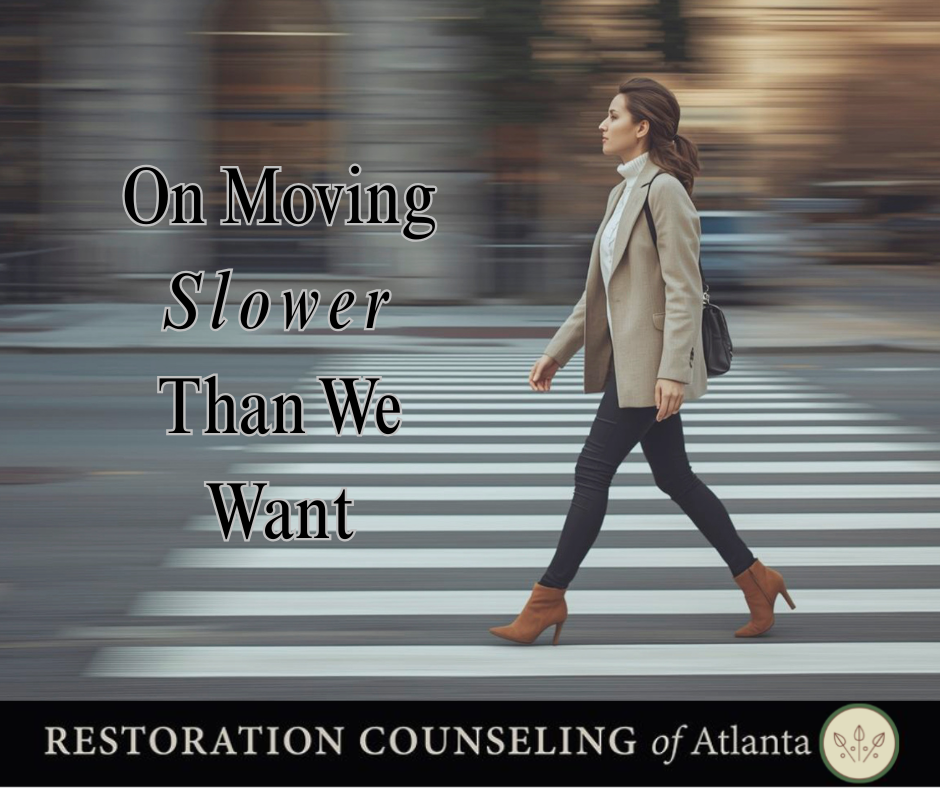
The Pace We Use to Stay Safe
In a world that prizes speed and efficiency, it can feel dangerous not to apply the same approach to our own healing. Many of us tackle recovery as a challenge to be solved, pressuring ourselves to adapt quickly, execute improvements, and keep moving forward. We push and prod ourselves with therapeutic insights, biblical guidance, and sheer will. We tally what we should know, what we should feel, what we should do — as if understanding automatically translates to capacity. And when we falter, even slightly, we feel the pull to hide, to figure it out alone, to move faster, to outrun the very limits and needs that make us human. Speed becomes a shield: if we go fast enough, maybe our uncertainty won’t be noticed, maybe our imperfection won’t be exposed, maybe our need for help won’t feel shameful.
When the Pace Breaks Down
Even the fastest stride eventually meets its limit. In therapy, this may show up as insight arriving faster than integration or reflection, sparking overwhelm instead of clarity. Confusion, anxiety, and self-criticism can flood in. For many of us, this state brings a terrified scramble to hide — a moment where we begin to agree with the lie whispered in the Garden, that shame has the last word. Shame, embarrassment, guilt, and anger often arrive together. The terror isn’t simply that we are slow — it is that slowing down makes our dependence visible, our needs undeniable, and our imperfect humanity unavoidable.
You may notice your body responding: tension in the shoulders, a tight jaw, fluttering in the chest, a hollow ache in the stomach. You might feel frozen, panicked, or compelled to push harder. These sensations are not signs of failure. They are signals that your nervous system is encountering limits — real, relational, and human. Allow yourself to notice them without judgment, to breathe through them, to feel what is present. Therapy can be a safe space to experiment with this: to slow down, to pause, to witness your own limits without collapsing.
The Lie About Needing
Many of us are taught, implicitly or explicitly, that needing support is weakness, that dependence is failure. But this is not true. Humans were designed to be finite, relational, and dependent. God is not surprised by our limits, nor offended by our vulnerability. Our weak points are often the very places where His presence — and the relational work of therapy — can meet us most fully. Feeling need does not signal sin; it signals life, growth, and relational opportunity.
The Therapeutic Reframe
What if growth was never meant to outrun need? What if capacity grows not by speed, but by presence, reflection, and relational engagement? In therapy, this can be seen when a client experiments with saying “enough,” notices their body’s tension when pushing too hard, or allows a practitioner to witness struggle without judgment. Even small pauses — a breath, a reflective silence, a moment of prayer — are therapeutic acts. The slower pace is not failure; it is where vulnerability becomes visible, where integration and transformation can occur.
You may feel shame, guilt, anger, or disappointment at not being “faster” or “better.” That is human, and it is legitimate. You may fear exposure, worry about miscalculating, or anticipate critique. That too is human. Yet, even amidst these mixed feelings, you are not alone. God knows this pace, this struggle, this terrifying middle ground. He meets us there, not to condemn, but to hold and sustain.
You may not be moving slowly because you are resistant. You may be moving slowly because you are human. And the need you are trying to outrun may be the very place therapy — and God — intends to meet you. There is no shame in the pause, no condemnation in dependence, no failure in taking the time required to live fully, feel deeply, and receive what cannot be carried alone.
 Written by: Becca Cline, LPC
Online Counseling Team
becca@restorationcounselingatl.com, ext. 156
Becca Cline wants to help you navigate the unexpected, make meaningful changes, and ultimately feel better. Becca works with adult men and women who may appear successful on the outside but feel unfulfilled, stuck, or struggling in the areas that matter most. Sometimes life looks fine — even good — and still doesn’t feel quite right. She offers a supportive, non-judgmental space to explore what’s beneath the surface. Whether you’re navigating unwanted behaviors or symptoms, enduring loss or transition, or working through past wounds, relationship challenges, or spiritual questions, she will work with you to bring clarity, healing, and a deeper sense of connection — to yourself, to God, and to others.