In John 5:2–8 (New Living Translation 2007), Jesus encounters a man who had been sick for thirty-eight years. He was lying near the pool of Bethesda, a place associated with healing, yet year after year he remained in the same condition. When Jesus asked him a striking question—whether he wanted to be made well—the man’s response focused on his circumstances. He explained that no one helped him into the pool when the water was stirred.
Jesus then told him, “Stand up, pick up your mat, and walk!”
This passage offers a meaningful perspective for those participating in mental health therapy. Healing is ultimately in God’s hands, but that does not mean we have no role in the process. Therapy often invites us to examine what we are carrying, what we believe, and what we are willing to surrender so we can move toward greater freedom.
Surrendering What We Are Wrestling With
Many people enter therapy carrying anxiety, shame, anger, grief, fear, resentment, or deeply rooted beliefs about themselves. Sometimes we spend years wrestling with the question, Why am I still like this? or Why hasn’t God changed this yet?
Surrender does not mean giving up. It means releasing our demand to control the outcome and becoming willing to trust God while faithfully participating in the work He has placed before us.
In therapy, surrender might look like acknowledging, “I cannot control what happened to me, but I can work on how I respond to it.” It may mean allowing ourselves to grieve instead of avoiding pain, challenging an unhealthy belief instead of automatically accepting it, or practicing a new behavior even when change feels uncomfortable.
Faith and therapy can meet in this space. We can bring our struggles honestly before God while also taking the next step available to us.
External and Internal Locus of Control
Psychology often describes this difference through the concepts of external and internal locus of control. A person with a primarily external locus of control may believe that their life is determined largely by circumstances, other people, fate, or forces outside themselves. Someone with a stronger internal locus of control recognizes areas where personal choices, attitudes, boundaries, and behaviors can influence outcomes.
Neither perspective means that we control everything. We do not.
We cannot control another person’s choices, erase our past, guarantee a particular outcome, or manipulate God into giving us what we want. But we can take responsibility for our own responses, seek help, establish boundaries, practice healthier coping skills, and decide whether we will continue participating in our growth.
For the person at Bethesda, Jesus did not ask him to control the pool, the crowd, or the actions of others. He asked him to respond to the invitation in front of him.
Legalism Cannot Heal the Heart
Another obstacle to healing can be the belief that if we try harder, behave better, pray enough, or follow every rule perfectly, we will finally become acceptable or whole.
That is legalism, and it can quietly turn faith into another source of shame.
In Sinclair Ferguson’s 2016 book The Whole Christ, he argues that one subtle form of legalism is not merely thinking, “I earn salvation by works.” It can become: “I must perform well enough to feel okay with myself.”
That can produce an exhausting spiritual cycle:
Failure → self-condemnation → renewed effort → temporary success → pride/security → inevitable failure → self-condemnation.
The person may affirm justification by faith doctrinally while functionally living as though acceptance depends on performance.
Christian growth is not a transaction in which perfect behavior earns God’s love. We do not have to punish ourselves into becoming healed people. God’s grace invites transformation from a foundation of relationship with Him, not condemnation.
Biblical self-compassion interrupts the cycle.
Biblical Self-compassion Brings Sanctification
Self-compassion is not excusing harmful behavior or avoiding responsibility. Instead, it means responding to our struggles with the same honesty, patience, and kindness we might extend to someone we love.
When I fail, I don’t have to say:
“I’m worthless.”
Nor do I need to say:
“What I did doesn’t matter.”
Instead:
“What I did was wrong. But my failure is not my identity, and I do not need to run away from God because of it. I can confess it, receive forgiveness, and return to Christ.”
That is neither self-condemnation nor self-excuse. It is repentance grounded in grace.
Compassion, as demonstrated in the Bible, is a profound expression of love and mercy, reflecting God’s character. It involves a deep empathy for others, leading to acts of kindness and service. Compassion is central to the teachings of Jesus, who embodied it throughout His ministry.
Since you are a child of God, you must practice self-compassion to become more like Jesus, for that is what He does for you as your intercessor.
Get Up and Take the Next Step
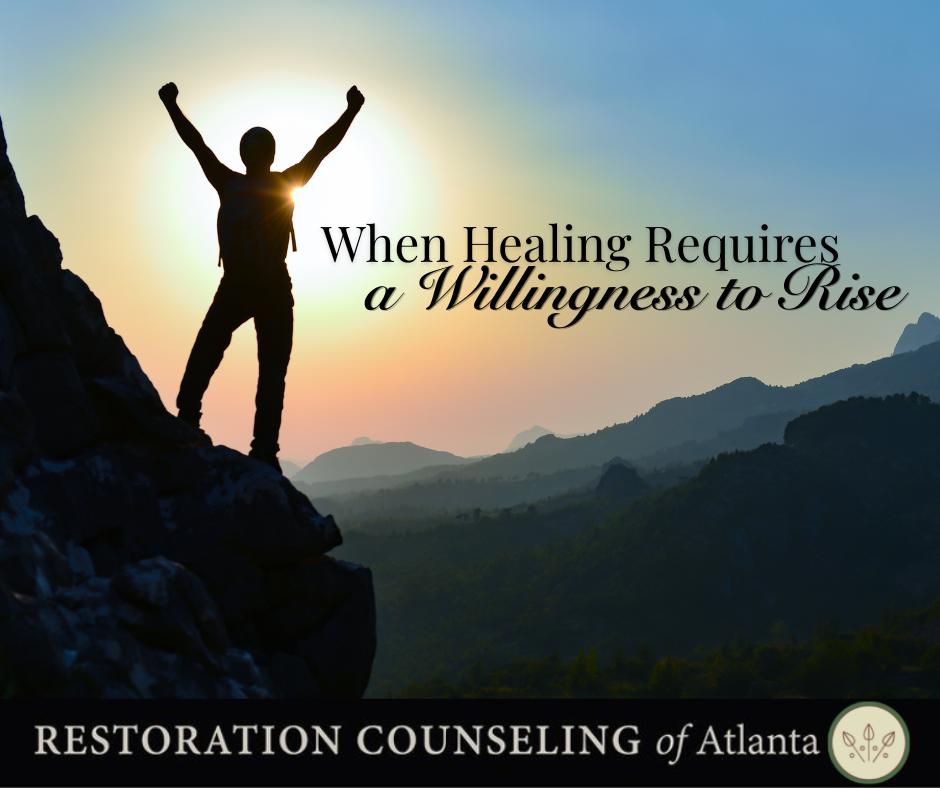
The man at Bethesda had a long history of disappointment. Yet Jesus called him toward action.
Therapy can be similar. Your therapist cannot do the work for you. A counselor can provide support, insight, skills, accountability, and a safe place to explore difficult experiences—but you ultimately participate in the work of change.
Perhaps your next step is setting a boundary. Perhaps it is telling the truth about what hurts. Perhaps it is challenging a lifelong belief, forgiving yourself for being human, or surrendering the outcome you have been trying desperately to control.
Faith does not require us to understand every step before taking it. Sometimes healing begins with trusting God enough to take the next one.

Written by Paige Santmyer, MA LPC NCC CCATP
Roswell location
paige@restorationcounselingatl.com, ext. 157
Paige provides counseling to adults ages 18+ experiencing anxiety, depression, relationship issues, parenting struggles, and life transitions. She uses a personalized approach of Client-Centered Therapy and Relational Psychoanalysis, as well as techniques from Cognitive Behavioral Therapy (CBT), Positive Psychology, and Exposure and Response Prevention (ERP). She has a certificate in both anxiety and trauma treatment.