
Growing up, my father was constantly making me and my sister practice reframing our statements in more positive and less critical ways as a way “to create a positive mental attitude,” as he called it. He backed it up with a merit/demerit system to enforce the message that how you think about things affects your success or failure. I’m not sure whether he read a lot about psychology or was just naturally gifted in mental toughness, but I believe this lesson in staying positive has made me more resilient and worry much less throughout my life. When I began reading The Anxious Perfectionist: How to Manage Perfectionism-Driven Anxiety using Acceptance and Commitment Therapy by Clarissa Ong and Michael Twohig (2022), my father’s wisdom was echoing in the lessons and can be learned by all.
Anxiety has a way of shrinking our world. It narrows our focus, magnifies perceived threats, and convinces us that the way we’re seeing things is the only way to see them. And when we dig into a negative focus, it often pulls us into a rigid, fear-based lens. Thoughts feel urgent and important, emotions feel overwhelming, and the impulse to control or avoid becomes strong. But what if the goal isn’t to eliminate anxiety, but to change our relationship to it? This is where Acceptance and Commitment Therapy (ACT) offers profound insight.
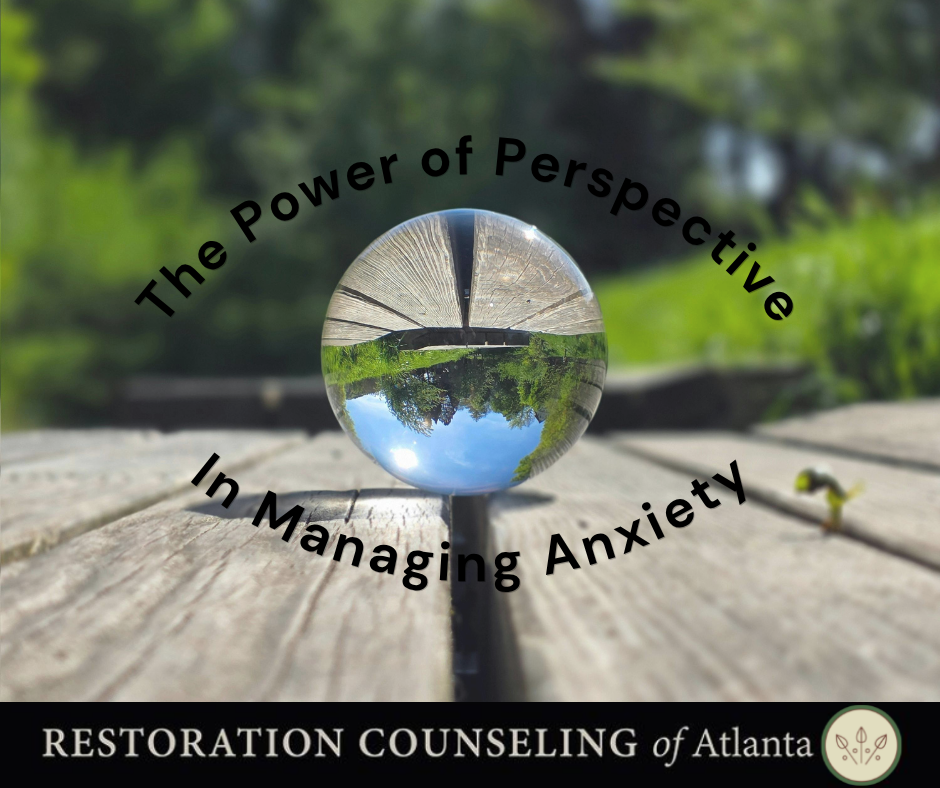
ACT teaches that psychological flexibility—the ability to step back, observe our internal experiences, and choose actions aligned with our values—is key to long-term well-being. Perspective plays a central role in developing that flexibility. Instead of being fused with anxious thoughts (“This is dangerous,” “I can’t handle this,” “Something bad will happen”), we learn to notice them as mental events, not absolute truths.
In the book, the authors explore how perfectionism and anxiety often go hand in hand. Individuals caught in this cycle tend to view their thoughts as facts and their standards as non-negotiable. Perspective-taking allows for a gentle loosening of that grip. Rather than asking, “Is this thought true?” ACT encourages a different question: “Is this thought helpful in moving me toward the life I want?”
That shift is subtle but powerful.
In Exposure and Response Prevention (ERP) Therapy, we intentionally face feared situations without engaging in compulsions or avoidance. This process can feel counterintuitive and even frightening at first. But perspective helps anchor clients in a broader understanding of what they are doing and why. Instead of viewing exposure as dangerous, they begin to see it as an act of courage and growth. Instead of interpreting anxiety as a signal to escape, they learn to recognize it as a temporary internal experience that rises and falls on its own.
Perspective also helps normalize anxiety. Many clients come into therapy believing that their experience is unique or that their thoughts mean something significant about who they are. When we zoom out, we see that anxiety is a universal human experience. Thoughts are not moral judgments; they are simply products of a busy mind trying to protect us, often overzealously.
From a Christian perspective, this idea resonates deeply. Scripture repeatedly invites us to renew our minds and to take our thoughts captive—not by force, but by aligning them with truth. Anxiety often pulls us into future-focused fear, but faith calls us back to the present moment and to trust in God’s sovereignty.
Consider the invitation in Matthew 6:34: “Do not worry about tomorrow, for tomorrow will worry about itself.” This is not a dismissal of concern, but a redirection of perspective. It reminds us that we are not in control of every outcome—and that we don’t need to be.
ACT aligns with this spiritual principle by encouraging acceptance of what is outside our control and commitment to what matters most. When we stop struggling to eliminate every anxious thought or feeling, we create space to live more fully. Perspective allows us to hold our experiences more lightly, recognizing that feelings are temporary, thoughts are not commands, and discomfort does not have to dictate our choices.
In practice, this might look like noticing an anxious thought—“What if I fail?”—and responding with, “I’m having the thought that I might fail.” This small shift creates distance. It opens the door to choice. From there, we can ask: “What action would align with my values right now?” Perhaps it’s showing up anyway, taking a step forward, or trusting that our worth is not defined by performance.
For those with a Christian worldview, this can also be an opportunity to lean into faith: “Even if I fail, I am worthy, still loved.” Perspective reminds us that our identity is not rooted in our fears, but in something far more stable and enduring.
Managing anxiety is not about achieving a perfectly calm mind. It’s about learning to live a meaningful life alongside whatever thoughts and feelings arise. Perspective is the bridge that makes this possible. It helps us step out of the storm, even briefly, and remember that we are more than what we feel in the moment.
Reference
Ong, C.W. and Twohig, M.P. (2022). The anxious perfectionist: How to manage perfectionism-driven anxiety using acceptance & commitment therapy. New Harbinger Publications.
OpenAI. (2026). ChatGPT (Apr 14 version) [Large language model]. https://chat.openai.com/chat

Written by Paige Santmyer, MA LPC NCC CCATP
Roswell location
paige@restorationcounselingatl.com, ext. 157
Paige provides counseling to adults ages 18+ experiencing anxiety, depression, relationship issues, parenting struggles, and life transitions. She uses a personalized approach of Client-Centered Therapy and Relational Psychoanalysis, as well as techniques from Cognitive Behavioral Therapy (CBT), Positive Psychology, and Exposure and Response Prevention (ERP). She has a certificate in both anxiety and trauma treatment.