
Awareness
“A man without self-control is like a city broken into and left without walls.” (Proverbs 25:28)
Continuing on our journey for emotional insight, communication, and stability, it is necessary to have strategies for inevitable distress. Whether there is a strong foundation of the type of community mentioned in Part 1, or there is an ongoing effort to find it, these tools will prove useful for the individual who has the desire and willingness to practice. That is something to remember: Practice is what will make these tools beneficial. Attempting to respond to emotional distress with these tools without practicing them first will result in frustration and discouragement. Consistency and “muscle memory” are everything. If you are not willing to put time and effort into these tools, what you read next will not bring you change.
Primary and Secondary Emotions
Understanding the difference between primary and secondary emotions will be helpful language for these strategies. The terms were coined through the Emotion-Focused Therapy approach, with Drs. Leslie Greenberg and Sue Johnson as the developers. Simply put, we understand primary emotions as gut-level, foundational, and basic emotions (think fear, hurt, sadness, joy, surprise), while secondary emotions are habituated reactions to those basic emotions (anger, worry, numbness). If I am in a situation where I feel embarrassed or out of control (primary), I may respond with anger (secondary). In other words, you may not have an anger problem; you may have a control problem. Fill in the blank to personalize this. Some emotions are more complex than others. Shame is a great example. Feeling ashamed of something in my life or past may result in feelings of numbness or anxiety (reactions to the shame). On the other hand, being fearful (primary) may result in my feeling ashamed (secondary) of being fearful. To be emotionally aware, we need to be able to pinpoint the primary emotion beneath the secondary.
Practically speaking, make this statement next time you feel angry, worry, tempted, etc.: I feel [blank] because I feel [blank]. Do this until you hit a primary emotion. This will highlight where your work needs to be.
Disconnection, Enmeshment, and Codependency
Think of your closest relationships. In these relationships, we are somewhere on a continuum. The continuum includes extremes that we will call “disconnection” and “enmeshment”. Disconnection is a state where we are emotionally cut off from each other, and there is very little opportunity for intimacy. Enmeshment is a state where we are so emotionally tied together that we do not know where one person’s emotions end and the other’s begin. This experience leads to volatility and very little stability in a relationship. I would call both of these states codependent (the other person’s emotional state dictates your own). As emotionally healthy individuals, we want to be in a balanced state.
Imagine that on this relational continuum, there is a healthy middle ground where we engage with both “containment” and “attunement”. Containment is acknowledging that you and the other individual have two separate emotional worlds, and you are responsible for your own. This is not a bad thing, as long as attunement is present. Attunement is the ability to empathize AND communicate empathy (empathy is most helpful when the other knows you empathize). If we contain too much and never attune, we are disconnecting. If we overly attune and never contain, we enmesh. We need to balance ourselves in the middle.
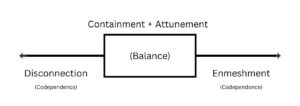
With a close relationship in mind, ask yourself what emotions you experience from the other person. Which emotions lead to discomfort in you? Does your wife’s anxiety lead you to withdraw or to try and fix it? A healthy approach would involve regulating yourself to maintain emotional agency, while expressing curiosity and compassion for her distress. Instead of disconnecting or enmeshing, contain and attune.
Remind yourself that you do not need to be immersed in or directed by someone else’s emotions. This will open the door for safe curiosity and empathy.
Side note: A good empathizer can pinpoint another’s primary emotions.
The Awareness Wheel
Another strategy in developing awareness is Sherod Miller’s awareness wheel. There is a lot we unconsciously do when faced with an issue, and this process is about slowing ourselves down enough to become more conscious and, therefore, more in control of our responses. This exercise focuses on sensory data, interpretations, feelings, desires, and actions. Here is an example:
“It seems like you are being quieter than normal (Sensory data), and I think you are frustrated with me (interpretation). When I think about that, I feel confused and worried that I have done something wrong (feeling). I want to know if you are upset, and I want us to talk openly with each other (wants). In the past, I have avoided you when I think you are frustrated with me, but I chose to press in this time (action).”
Consider this new way of communicating in your relationships, as it leads to fewer accusations and less defensiveness. More to the purpose of this article, this process will help you learn about yourself. Whether the situation is with your wife, boss, coworker, roommate, child, or parent, this tool creates opportunity for emotional growth and maturation. Taking 10-15 minutes to write out a response with these components will help you be more honest, boundaried, loving, and gracious.
Conclusion
With more community comes the opportunity for relationships. Seeking insight into your primary emotions, codependent patterns, and automatic thinking will increase the intimacy of these relationships. Again, these practices take practice! Commit and discipline yourself to engage with these concepts regularly, and they will feel less robotic and more meaningful. Next, we will explore the value of narrative work and the process through which the pain and shame of your past can equip rather than paralyze you.

Written by: William Palmer
william@restorationcounselingatl.com; 678-534-3824, ext. 124
William Palmer (Roswell & Woodstock) has a passion for working with males of all ages who experience issues involving anger, anxiety, career, community, depression, identity, pornography, relationships, self-harm, suicidality, shame, spirituality, and trauma. He is also passionate about working with couples. He is trained in implementing Person-Centered Therapy, Cognitive Behavioral Therapy, Internal Family Systems, Emotion-Focused Therapy, and Play Therapy. William views individuals and their presenting issues through the lens of attachment theory, interpersonal neurobiology, and trauma-informed theories, all under the authority of God’s Word.