What is a “Cognitive Distortion”?
Have you ever had recurring thoughts you can’t shake? Perhaps you ruminate on moments, memories, or experiences with no end in sight? Thoughts that begin with phrases such as “What if…, “I can’t…”, “I’ll never…” or “I shouldn’t have..”. Notice how these thoughts utilize permanent language and often present an absolute truth. These thoughts are not coincidental; rather, they are learned patterns of thinking called “cognitive distortions”. Cognitive distortions are irrational or biased thought patterns that warp how we interpret ourselves, our circumstances, or the world around us.
How do Cognitive Distortions Form?
Cognitive distortions can develop through repeated experiences, particularly during seasons of trauma, stress, or hardship. During difficult experiences, our minds naturally attempt to make sense of what is happening and find ways to protect us from future harm. In other words, we can develop “survival rules” that help us navigate difficult circumstances. When a moment reminds us of a past hardship, the mind instinctively draws on past experiences to inform present-day thinking. Negative thoughts often result from these patterns of thinking because the brain perceives them as rules that aid “survival” and promote “safety.” The mind adapts during hardship but cannot return to previous states without intentional intervention.
For example, during a season of financial hardship, thoughts of scarcity may create sensations of anxiety that help you remember not to spend extra on eating out when there’s food at home or to avoid spending unnecessarily on guilty-pleasure items. During this time of financial hardship, these thoughts serve as protective reminders. After the hard season passes, scarcity-based thought patterns may remain because the mind can’t distinguish between a season of hardship and a return to normalcy.
Negative thinking is less about thoughts and more about learned patterns. Negative patterns of thought can become the new “normal” when the mind’s perception is skewed due to trauma or hard experiences.
Breaking the loop begins with an intentional pause…
Interrupting negative thought loops begins with an intentional pause. The mind is incredibly intuitive but can’t discern context on its own. I believe this is why the Bible tells us, “take every thought captive to make it obedient to Christ” (2 Corinthians 10:5, NIV). This verse is not intended to make us doubt the natural divine design of our minds, but rather to implore us to remain aware of whether our thoughts are aligning with how Christ would view our situation.
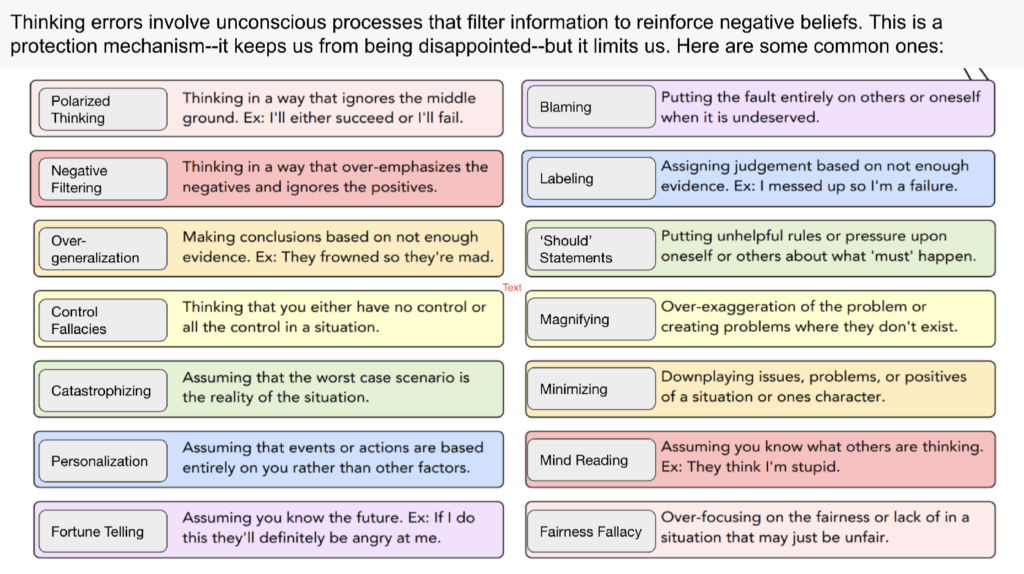
Above are some common examples of cognitive distortions. When we recognize and identify distorted patterns of thinking, we have the opportunity to interrupt them. Once we become aware, we intentionally pause and label the thought pattern. This signals to the mind that this pattern is not appropriate for the current situation. The pause creates space between the thought itself and our reaction. We can use this space to introduce healthy alternative thoughts. For example, a thought of scarcity such as “If I spend any more, I’ll run out of money and be unable to pay important bills” can be reframed from “I’m concerned about the outcome of my finances if I spend. Although I know that I have budgeted for this purchase and will be okay making it.”
Remember, the goal is not to completely eradicate ALL negative thoughts, as it is human to experience them. Rather, the goal is to regulate and check the influence of negative thought patterns. A small, intentional pause can be the catalyst for constructing healthier thought patterns.

Written by: Khambrel Rembert
Khambrel (Roswell) is a graduate student intern with a distinct passion for helping people move towards hope and healing. With over four years of mental health experience, specializing in children, adolescents, and families, he offers a safe, compassionate space to explore life’s challenges—whether that be anxiety, burnout, past traumas, or major transitions. His person-centered approach blends warmth with proven techniques to meet your unique needs. Khambrel believes that no one should have to carry the weight of life’s challenges alone. He would be honored to walk with you as you take steps toward the life you want to live.