
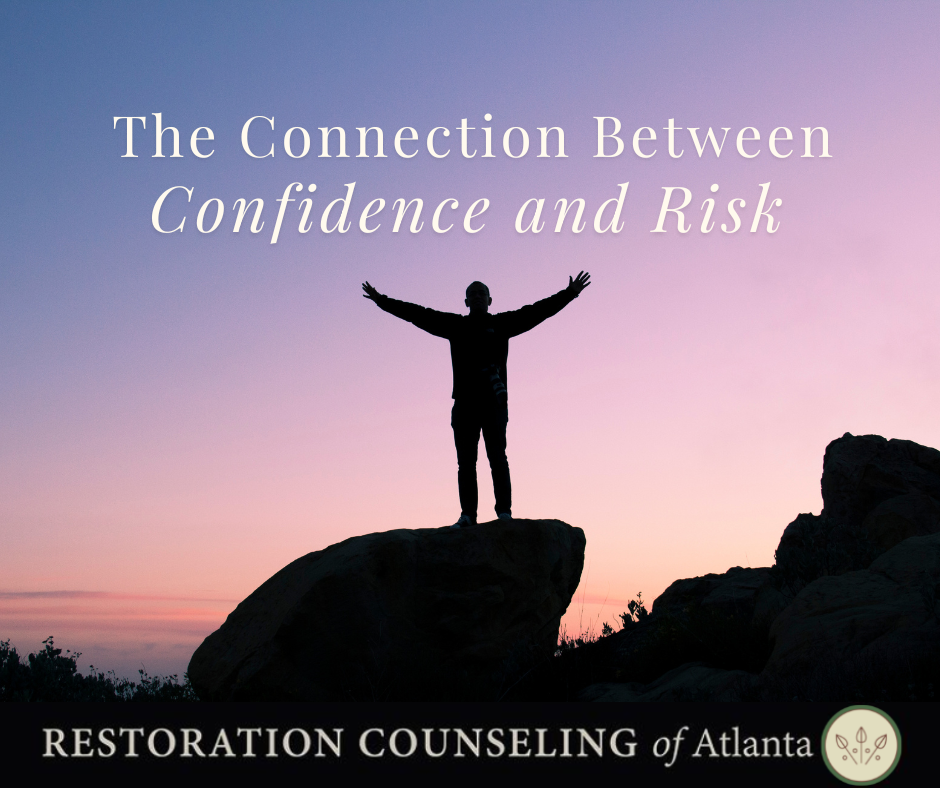
Recently, I’ve talked with many clients about taking risks. When we begin the discussion, I realize I am thinking about taking risks very differently from the person I’m talking to. Most of the time, they are thinking about big events like skydiving, cliff jumping, or moving to a completely different field of work–all risks indeed. However, when I bring up risk, I am trying to bring attention to the reality that we take risks every day, some more than others, and risks of varying sizes. Confidence in ourselves and our relationships stems from our attunement to and evaluation of the risks we take and “accomplish”. Let’s explore why this is and how to begin this process.
Child Development Lens
Theraplay, a psychotherapy for supporting parent-child attachment, identifies challenge as a pillar of increasing attachment and ultimately a child’s self-esteem. I imagine not everyone reading this article is a parent or interested in child development, but hear me out: this modality aims to support connection and attachment by structuring activities to build attunement and understanding of self and the world. From this understanding and a secure attachment, Challenge is one of the focus areas the activities are structured around. This is characterized by the parent and child taking developmentally appropriate risks to build the child’s competence, self-view, and the connection between them. Research shows that taking developmentally appropriate risks within the safety of a relationship (in this model, someone older/wiser) builds that little human’s confidence. It also motivates them to continue growing, knowing they are capable of making a positive impact on the world. In other words, taking appropriate risks and mastering new skills builds our self-concept and confidence, allowing us to move towards others and the world around us… But what makes the risk appropriate vs inappropriate?
Appropriate vs Inappropriate Risk
I imagine we can all reflect on an experience where we were pushed beyond our limits or placed entirely too much significance on something that was never meant to bear the weight. We walk away from these moments and experiences with discomfort and confusion, to put it mildly. To take a risk haphazardly and push ourselves into spaces we’re not ready for can bring self-doubt and self-criticism. Yet, at the same time, by never pushing ourselves into discomfort, we stay stuck and unsure of our ability to grow and to feel the survivability/resilience God has given us. How do we strike the balance of discomfort yet appropriate risk? We reflect, we try, and we evaluate. Below are some questions to begin this process.
Reflect
When evaluating developmentally appropriate risk, it’s helpful to reflect on past experiences:
- Where have I taken risks that went well?
- When was the last time I pushed myself through something uncomfortable? What did my body feel like before/during/afterwards?
- What does it feel like when I accomplish a new task and work hard to master something new?
- What is the last accomplishment I remember experiencing?
- What have I learned about myself in the process of taking risks?
Try
Start to notice and reflect on the risks you take every day. We can take risks big and small. Here are some areas to “risk” and notice yourself in the process:
- Try a new food. Invite your family or friend group to try with you.
- Try a new park for a walk.
- Try a new restaurant.
- Try to take someone at their word and not ask, “Are you sure?”
- Try to ask a friend a question you’ve never asked before.
- Try a new hobby–crochet; knit; woodworking; kickboxing; etc.
- Try to hang out with a friend and not mention something you’re anxious about.
- Try to hang out with a friend and share something you’re anxious about.
- Try to ask someone out on a date.
- Try to ask someone to pray specifically for your need.
- Try to tidy the house for 10-minutes at the end of the day.
- Try to skip the laundry for one day.
- Try to let your children make dinner (if age-appropriate).
- Try to create a list of 10 new experiences to grow your attunement to and evaluation of risk-taking.
Evaluate
When building competence and confidence, evaluating the risk you’ve just taken (or not taken) is crucial. Here are some questions for evaluation of new things:
- What is something new I did today?
- How did I feel before, during, and after the experience?
- If I avoided taking a risk, how come? What led to that decision? How did my body feel before, during, and after?
- What did I learn about myself in this process?
- How did I notice tension/discomfort?
- How did I manage tension/discomfort?
For Further Thought
For parents:
Give your children the opportunity to take age-appropriate risks and help them evaluate their experience afterward. Confidence is not simply a personality trait, but something fostered over time. To foster confidence in children, practice giving them age-appropriate challenges and process afterward. Celebrate accomplishments and get curious about struggles.
For young adults:
The areas I see most people exploring risk at this age are dating and career choice. It’s difficult to take big risks when we’ve not given ourselves the opportunity to take “smaller” risks and feel the tension and stress of those moments. Refer to the “Try” list above and add more risk-based exercises to continue building your trust in your ability to manage the tension risk-taking brings, and ultimately build confidence.
If this article reads as if I have it all together, let me assure you that is not true. I, like my clients, am in the process of reflecting, trying, and evaluating myself. This process can feel less daunting in the presence of safe others, whether that be a therapist, best friend, or spouse. Reach out via email if you’d like to discuss this more.

Written by Samantha Mathews, MA, AMFT, APC, NCC, CMHC
Woodstock location

samantha@restorationcounselingatl.com
Samantha works with individuals of all ages. She wants to help create space and language for what you may be going through in life. Samantha sees individuals dealing with ADHD, anxiety, depression, gender issues, grief, postpartum depression, and trauma. She also does premarital and marital counseling.